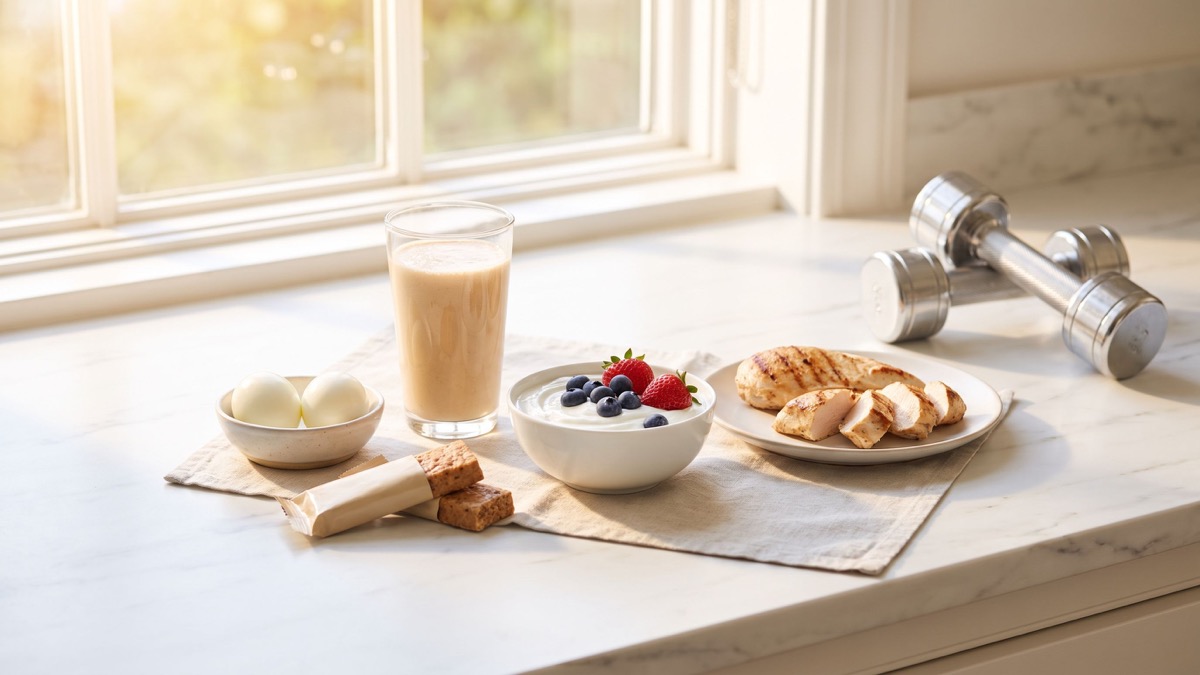
I coach a lot of women who train hard and still get protein wrong. Not because they’re careless. Because the advice they’ve been handed is either scary (“you’ll get bulky”) or vague (“eat more protein!”) or built for someone who doesn’t lift a thing.
So they undereat it. They keep what’s on their plate the same and hope. And they wonder why the strength isn’t showing up.
Here’s the short version: protein is the single most useful thing on your plate if you want to build and keep muscle. Below are five things worth knowing, each grounded in real research. No fear, no hype, just what actually holds up.
TrakMac may earn a small commission from the links on this page, at no extra cost to you. We only point to products we’d actually use ourselves.
1. Protein won’t make you bulky
Let’s kill this one first, because it drives so much undereating.
Muscle is slow to build. Even with hard, consistent lifting and plenty of protein, meaningful size takes months, and usually a calorie surplus you’d have to work at to reach. Protein doesn’t create bulk on its own. It supplies the raw material your body uses to repair and build the muscle you earn under the bar.
Eat more protein while training hard and what you get is stronger, more defined, and fuller between meals. Not big. The women who look “toned” in the way people mean it are the ones eating enough protein and lifting with intent. That’s the whole trick.
2. You probably need more than you think
The number stuck in most people’s heads is the government minimum, roughly 0.8 grams per kilogram of bodyweight. That’s the amount to avoid a deficiency sitting still. It was never meant for someone putting a bar on their back.
A well-known meta-analysis by Morton and colleagues found that protein intake up to about 1.62 g/kg drove additional gains in strength and muscle from resistance training, with the defensible upper bound landing near 2.2 g/kg. That’s roughly double the minimum. For a woman who trains, 1.6 g/kg is a sane floor, not a stretch goal.
There’s a bonus. Protein is the most filling macro and takes the most energy just to digest. The thermic effect of protein runs around 20 to 30 percent of its calories, versus 5 to 10 for carbs and almost nothing for fat. So hitting your protein tends to keep you fuller on fewer total calories. Useful, without a single restriction rule.
If whole food isn’t getting you there, a scoop of something like Optimum Nutrition Gold Standard Whey (24g protein per scoop) is the least fussy way to close a 20-gram gap.
3. Total protein beats perfect timing
You do not have to slam a shake within 30 minutes of your last rep. The “anabolic window” was oversold.
When Schoenfeld and Aragon pooled the timing studies and controlled for total daily protein, the timing advantage vanished. The studies that seemed to prove a magic post-workout window were quietly comparing groups that also ate more protein overall. Match the totals and the clock stops mattering.
What this frees you to do: stop stressing about minutes. Hit your daily number across three or four meals of 30 to 40 grams, and land them whenever your day allows. A Fairlife Core Power Elite (42g protein per bottle) in the car counts exactly as much as a chicken breast at the table. The total is the target.
4. Strength training is what makes the protein count
Protein and lifting are a pair. One without the other underdelivers.
All those intake numbers come from studies where people were resistance training. That’s the part that tells your body to spend the protein on muscle instead of storing or burning it. Extra protein with no training stimulus is just extra calories. Lifting hard with too little protein leaves gains on the table.
So the order of operations is simple. Lift with intent, progress the load over time, and feed it with enough protein. That’s the engine. Everything else, cardio, steps, the rest, is support around it. If you take one thing from this post, make it this: the protein is the point because the training is the point.
5. Tracking beats guessing (and it doesn’t have to be a chore)
Here’s the quiet problem behind all four points above. Most people who “eat a lot of protein” are 20 to 40 grams short of their target and have no idea, because they’ve never actually counted.
You can’t fix a number you don’t measure. You don’t need to weigh every gram forever, but you do need to know where you land on a normal day. Start with this cheat sheet, then check yourself for a week.
| Bodyweight | Floor (1.6 g/kg) | Higher end (2.0 g/kg) |
|---|---|---|
| 130 lb (59 kg) | ~94 g | ~118 g |
| 140 lb (64 kg) | ~102 g | ~127 g |
| 150 lb (68 kg) | ~109 g | ~136 g |
| 160 lb (73 kg) | ~116 g | ~145 g |
| 170 lb (77 kg) | ~123 g | ~154 g |
Bias toward the higher end on hard training weeks or when you’re eating in a deficit to hold onto muscle. A couple of Quest Protein Bars (21g protein each) in a bag can quietly cover the days that go sideways.
The bottom line
Protein won’t make you bulky. You need more than the minimum, probably around 1.6 g/kg. Total matters more than timing. The training is what makes it work. And the only way to know you’re actually hitting the number is to track it.
That last one is where most people quit, because logging is a pain. Fumbling a database, searching for a brand, tapping serving sizes. It’s why good intentions die by Wednesday.
That’s the exact friction TrakMac removes. You just say what you ate. “Two eggs, a Core Power, and a chicken bowl.” It estimates the protein and subtracts from your target in about 8 seconds. No barcode, no database dive, no guessing whether you hit your number. You just know.
Keep what you’re building. Hit your protein, lift with intent, and let the logging take 8 seconds instead of your evening. Download TrakMac free on iOS, or read more about how the protein math works in the FAQ.