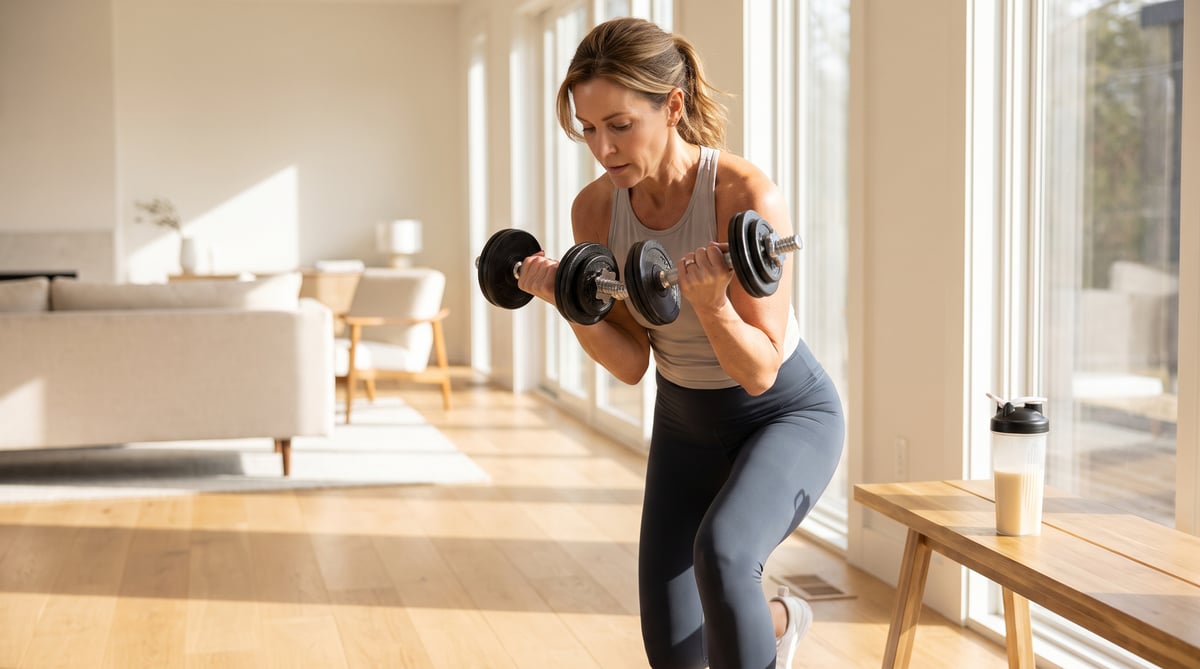
I started lifting seriously later than most people expect. “I should get strong” had been on the list for a while, and the list kept winning. What finally moved me wasn’t a before-and-after photo. It was realizing that strength is the one thing you get to keep compounding, and every year you wait is a year you don’t get back.
Here’s what nobody tells busy women: you do not need a complicated program. Not five days a week, not a coach, not a spreadsheet with tempo notation. You need a handful of the right movements, a way to get a little stronger each week, and enough protein to actually build something.
That’s the whole plan. Let me give it to you straight, no fluff, so you can start this week.
TrakMac may earn a small commission from the links on this page, at no extra cost to you. We only point to products we’d actually use ourselves.
Why strength training is the long game
Muscle doesn’t stick around out of politeness. It stays because you keep asking it to do hard things. Stop asking, and the body has no reason to hold onto tissue it isn’t using. That’s the whole case for lifting in one sentence: it’s the signal that tells your body to keep what you’re building.
Cardio is great for your heart. Walking is great for your head. But neither one tells your body to hold onto muscle the way picking up something heavy does. Strength training is the specific stimulus, and there’s no substitute that comes in a pill or a class.
Better still, the response to that signal doesn’t expire. Start now and you get meaningfully stronger. The plan below sends that signal two or three times a week, which turns out to be exactly enough.
The plan: full body, 2-3x a week
You’re going to train your whole body each session, two or three times a week, with a day of rest in between. That’s it. This isn’t a compromise for beginners; it’s what the evidence supports. When researchers match the total amount of work, training a muscle two to three times a week produces strength gains as good as higher-frequency splits (Schoenfeld et al. meta-analysis). Major fitness bodies land on the same 2-3 days a week for the same reason.
Five compound movements cover your entire body. Each one trains several muscles at once, which is how you get the most strength for the least time. Here’s the template:
| Movement pattern | Example lift | Sets x Reps |
|---|---|---|
| Squat | Goblet squat (dumbbell held at chest) | 3 x 8-10 |
| Hinge | Dumbbell Romanian deadlift | 3 x 8-10 |
| Push | Dumbbell bench press or push-up | 3 x 8-12 |
| Pull | One-arm dumbbell row | 3 x 8-12 |
| Overhead press | Standing dumbbell shoulder press | 3 x 8-10 |
Do all five in one session. Rest 60 to 90 seconds between sets. If you have time and energy, add a farmer’s carry (walk holding a heavy dumbbell in each hand) or a 30-second plank at the end. The whole thing runs about 40 minutes, and you can do every movement with one pair of dumbbells.
Start lighter than your ego wants. The first two weeks are for learning the movements and finding weights where the last rep of each set is challenging but clean. That’s your launch pad.
The one rule that actually builds strength: progressive overload
Here’s the part that separates people who get strong from people who just show up: you have to make the work harder over time. That’s called progressive overload, and it’s the engine behind every strength gain you’ll ever make.
The simplest version is “double progression,” and you can run it forever:
- Pick a rep range, say 8 to 10.
- Start with a weight you can do for 8 clean reps on all three sets.
- Each session, try to add a rep. When you hit the top of the range (10) on all three sets, go up in weight next time.
- When you go up, you’ll drop back to the bottom of the range. Climb again.
That’s the whole game. Add a rep, then add weight, repeat. Your job every session is to beat last session by a little. Write down what you lifted so you actually know what “a little more” means, because memory is a liar under a barbell.
If you only take one thing from this post, take this: consistency plus a slightly heavier version of last week is how strength is built. There is no faster path, and there doesn’t need to be.
The protein piece that makes it work
You can train perfectly and stall out anyway if you don’t give your body the raw material to build with. That material is protein, and most women starting out eat about half of what would actually serve them.
The number worth knowing: a well-known meta-analysis in the British Journal of Sports Medicine found that protein intake up to roughly 1.6 grams per kilogram of bodyweight per day maximizes the muscle and strength you get from lifting (Morton et al., 2018). For a 68 kg (150 lb) woman that’s about 110 grams a day. More than that mostly just costs money.
How you spread it matters too. Your body builds muscle best when protein arrives in solid doses across the day rather than all at dinner. Research suggests aiming for roughly 25 to 40 grams per meal to fully switch on the muscle-building response (Schoenfeld & Aragon, 2018). Three or four meals in that range, and you’re there.
If hitting protein from whole food alone feels like a second job, a scoop of whey is the easiest lever to pull. Optimum Nutrition Gold Standard 100% Whey puts 24 grams of protein and about 120 calories in one scoop with roughly a gram of sugar, so it’s an easy 24 grams toward your day without much thought. One shake often closes the gap between “I tried” and “I hit it.”
The only gear you actually need
You do not need a home gym. You need load you can adjust. A single pair of adjustable dumbbells runs the entire plan above and grows with you as you get stronger, which you will.
The Bowflex SelectTech 552 adjusts from 5 to 52.5 pounds per hand in small increments, replacing about 15 pairs of dumbbells in the footprint of one. That range is enough to progress on every movement here for a long time, and the small jumps are exactly what double progression needs. It’s the one purchase that removes the “I don’t have the equipment” excuse for good.
That’s the whole kit. Dumbbells, a bit of floor space, and a protein plan. No membership, no commute, no waiting for a squat rack.
The friction that actually derails people
Once the training and the protein target are sorted, the thing that trips women up is not the workout. It’s tracking whether they actually hit their protein, day after day, when life is loud.
You bought the dumbbells to keep what you’re building. The long game is muscle, and muscle runs on protein you actually eat most days, not the days you remembered to log. But nobody wants to open an app, search a database, and hunt for the right portion size while dinner burns and someone needs help with homework.
That’s exactly why TrakMac works by voice. You say “two eggs, a scoop of whey, and a cup of Greek yogurt” and the macros land in about 8 seconds. No search bar, no barcode, no scale. Just say it and move on. For women who train and want to know they’re actually feeding the work, that’s the difference between a plan on paper and results you can feel.
The bottom line
Strength after 40 isn’t complicated. Train your whole body two or three times a week with five compound lifts. Add a rep or a little weight each session. Eat around 1.6 grams of protein per kilo, in 25-to-40-gram meals. That’s the entire recipe, and it works because it’s simple enough to actually do for years.
The only variable left is whether you keep score on the protein without it becoming a chore. Download TrakMac free and log your meals by voice in about 8 seconds. Questions on how the estimates work are answered in the FAQ. Start this week. Your future strong self is built one slightly-heavier session at a time.