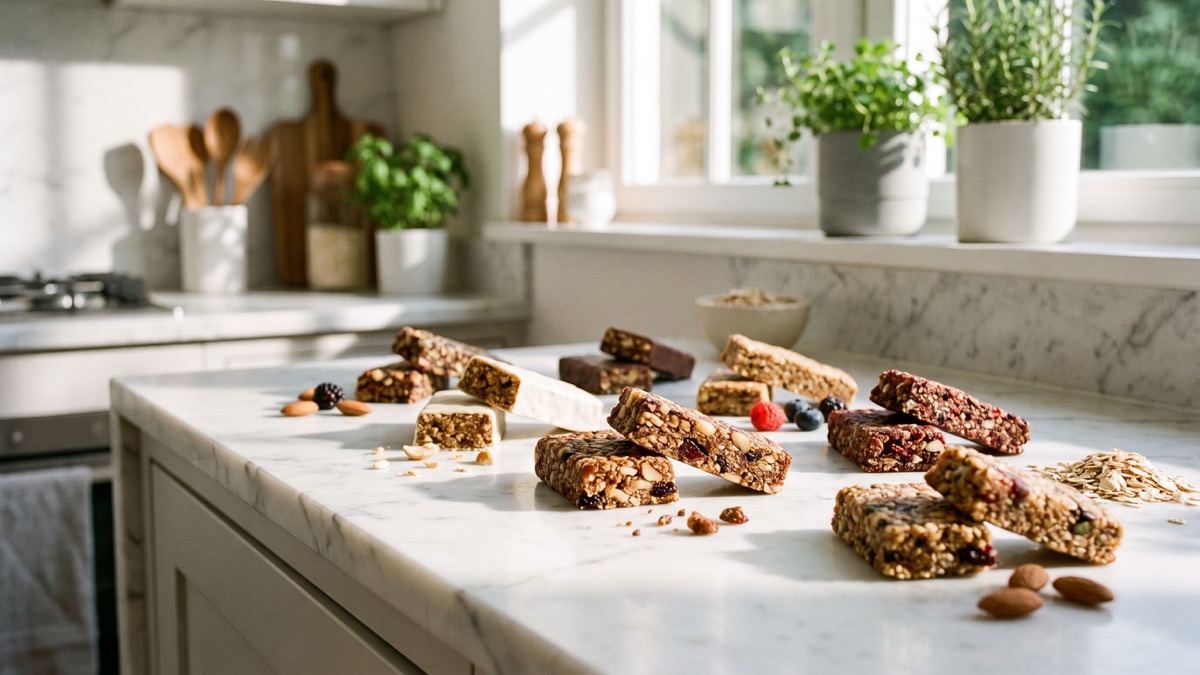
I got tired of turning over a bar labeled “protein” and finding 18 grams of sugar on the back. That is not a protein bar. That is a candy bar wearing a gym outfit.
When you train and you are trying to hold onto muscle, a bar is supposed to do one job: get protein into you fast, without a sugar spike you did not ask for. The good news is the category has gotten a lot better. There are bars now with 20 grams of protein and barely any sugar that actually taste like something you want to eat.
Here are the ones worth keeping in your bag, ranked by the thing that matters: the most protein, the least sugar, and a texture you will not have to force down. All numbers below are per bar and verified against the current labels.
TrakMac may earn a small commission from the links on this page, at no extra cost to you. We only point to products we’d actually use ourselves.
What “low sugar” actually means on a bar
Two quick things before the list, because the label is where most people get fooled.
First, “no added sugar” and “low sugar” are not the same as zero calories. These bars hit low sugar by using non-nutritive sweeteners: sugar alcohols like maltitol and erythritol, or plant-based ones like monk fruit, stevia, and allulose. Sugar alcohols are the ones that can leave some people bloated if they eat a few bars in a day. If your stomach is sensitive, favor the monk-fruit and allulose bars below.
Second, protein per calorie is the real tell. A bar with 20 grams of protein in 200 calories is working hard for you. A bar with 10 grams of protein in 280 calories is a snack with a protein sticker. Every pick here earns its calories.
David High Protein Bar
The current king of the protein-to-sugar ratio. David packs 28g of protein into 150 calories with 0g of sugar, which is close to a rounding error for the whole category. It uses a blend of milk protein, collagen, whey, and egg white, so the amino acids are covered.
Who it’s for: anyone who wants the maximum protein for the fewest calories, full stop.
Pro: nothing else touches 28g of protein at 150 calories. Con: the texture is firmer and drier than a candy-style bar, and it is one of the pricier options at roughly $3 per bar.
Macros: 28g protein, 150 cal, 0g sugar.
Quest Protein Bar
The one that started this whole category and still holds up. Quest gives you 20-21g of protein for around 190-200 calories with 1g of sugar or less, plus a big 14g of fiber. It is sweetened with erythritol and a little sucralose.
Who it’s for: the reliable everyday bar you can find in any grocery store.
Pro: widely available, tons of flavors, and one of the best protein-per-dollar deals at roughly $1.80 to $2 a bar. Con: the chew is dense and a little chalky compared to the newer candy-style bars, and the fiber load can be a lot for some stomachs.
Macros: 20-21g protein, ~190 cal, <1g sugar.
Barebells Protein Bar
The taste winner for a lot of people. Barebells delivers 20g of protein for around 200 calories with about 1.7g of sugar and no added sugar. The reason people love it: it tastes like a real chocolate bar, not a compromise.
Who it’s for: the person who quit protein bars because they all tasted like drywall.
Pro: genuinely enjoyable texture and flavor, still hits 20g of protein. Con: it uses sugar alcohols to get there, so a few in one day can bother a sensitive gut.
Macros: 20g protein, ~200 cal, ~1.7g sugar.
Grenade Carb Killa
A candy-bar experience that stays honest on the label. Grenade lands around 20-21g of protein and roughly 215 calories with about 2g of sugar. The caramel and nougat layers are the closest thing here to eating a mainstream candy bar.
Who it’s for: the sweet tooth who wants dessert energy without the sugar crash.
Pro: the best texture of the bunch if you miss real candy bars. Con: slightly higher in calories and sugar than the leaders here, and it leans on sugar alcohols.
Macros: 20-21g protein, ~215 cal, ~2g sugar.
Atlas Protein Bar
The pick if you want low sugar without sugar alcohols or artificial sweeteners. Atlas uses grass-fed whey and sweetens with monk fruit, landing 20g of protein and 1g of naturally occurring sugar in about 210-230 calories.
Who it’s for: the “read the ingredient list” crowd who wants a cleaner label.
Pro: monk-fruit sweetened, no sugar alcohols, so it is gentler on the stomach. Con: a bit higher in calories and fat, and it runs closer to $2.50 a bar.
Macros: 20g protein, ~220 cal, 1g sugar.
ONE Protein Bar
The flavor variety play. ONE gives you 20g of protein for around 220-230 calories with just 1g of sugar, and the flavor list is deep: birthday cake, maple donut, and so on for when a plain chocolate bar bores you.
Who it’s for: the person who needs novelty to keep a habit going.
Pro: fun, dessert-forward flavors that stay at 1g of sugar. Con: slightly higher calories and uses maltitol plus sucralose to get the sweetness.
Macros: 20g protein, ~230 cal, 1g sugar.
No Cow Protein Bar
The plant-based standout. No Cow hits 20g of protein from brown rice and pea protein for about 200 calories with 1g of sugar, sweetened with monk fruit, stevia, and erythritol. It is vegan, dairy-free, and soy-free.
Who it’s for: anyone eating plant-based who still wants a full 20g hit.
Pro: 20g of dairy-free protein at 1g of sugar is rare, and it carries a big 15g of fiber. Con: that fiber plus erythritol can be a lot at once, so ease into it if you are not used to it.
Macros: 20g protein, ~200 cal, 1g sugar.
The quick comparison
| Product | Protein | Calories | Sugar | ~Price/bar | Best for |
|---|---|---|---|---|---|
| David | 28g | 150 | 0g | ~$3.00 | Most protein, fewest calories |
| Quest | 20-21g | ~190 | <1g | ~$1.90 | Reliable everyday pick |
| Barebells | 20g | ~200 | ~1.7g | ~$2.00 | Best taste |
| Grenade Carb Killa | 20-21g | ~215 | ~2g | ~$2.30 | Candy-bar craving |
| Atlas | 20g | ~220 | 1g | ~$2.50 | Cleaner label, no sugar alcohols |
| ONE | 20g | ~230 | 1g | ~$1.90 | Flavor variety |
| No Cow | 20g | ~200 | 1g | ~$2.30 | Plant-based |
The part nobody tells you
Picking the bar is the easy part. The hard part is the same thing that trips up every protein plan: actually counting it toward your day. A bar is 20 grams that only helps if it lands on the total you are trying to hit, next to the chicken, the yogurt, and the shake.
That counting is the real friction, and it is exactly why we built TrakMac. You do not scan a barcode or dig through a database. You just say it. “Barebells cookies and cream bar.” Eight seconds, and the protein is on your daily total, subtracted from your target, done. No typing, no searching, no forgetting the bar you ate in the car.
That is the whole point: the bars have gotten good, but the logging is where people quit. Take the friction out of the logging and the protein habit sticks, which is what actually keeps the muscle you are working for. This is the long game, and it runs on the days you almost skipped tracking.
The bottom line
If you want the single best number, David wins on protein and sugar. If you want the best-tasting bar you will actually reach for, Barebells or Grenade win. If you want a cleaner label, go Atlas or No Cow. Buy one of each before you commit to a box, because taste is personal.
Then make it count. Download TrakMac free and log your protein by voice in about eight seconds, bar included. Want to know how the targets get set for someone who trains? That reasoning is right here.