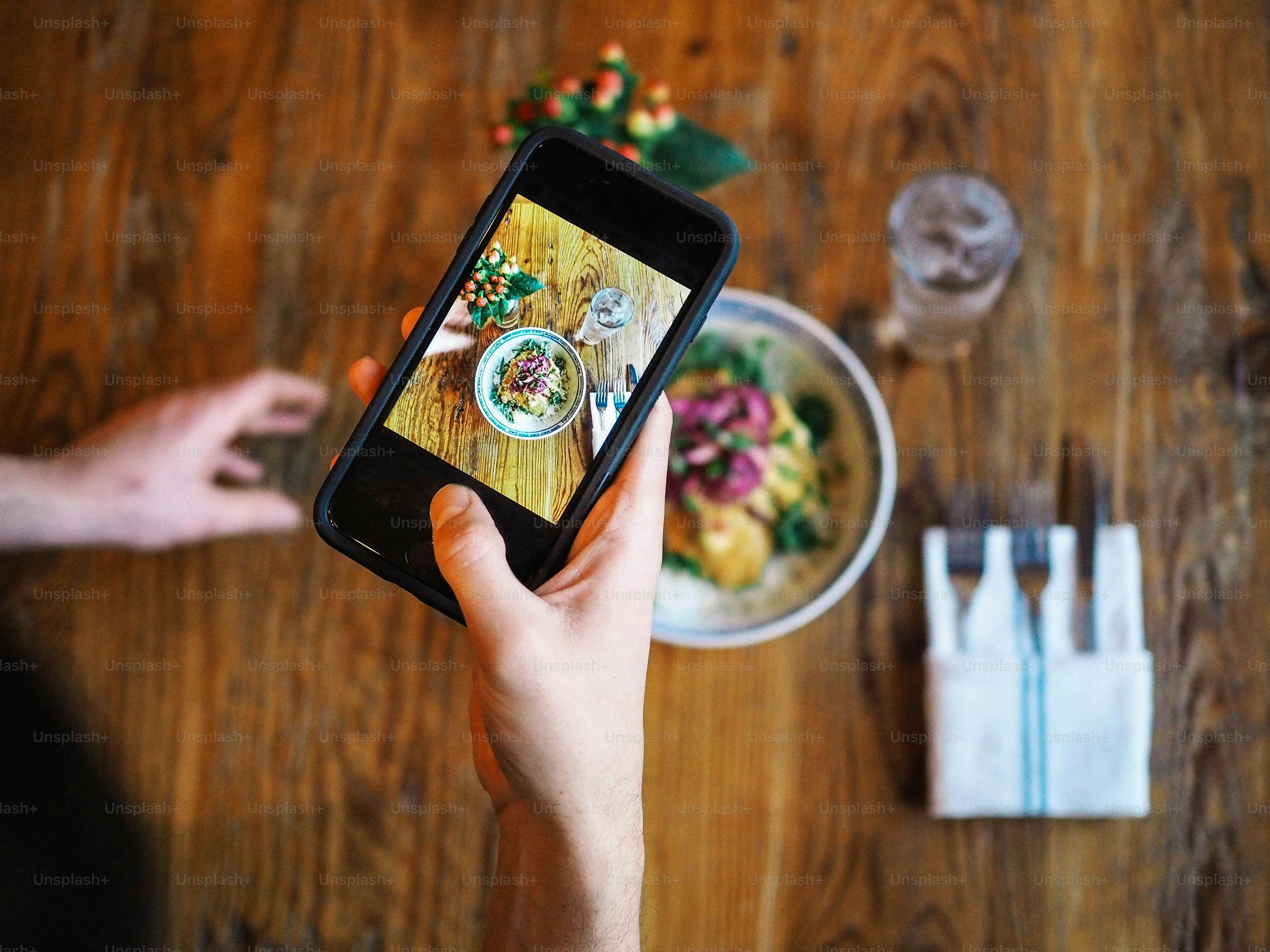
Your dietitian told you to track protein on your GLP-1. So you downloaded the app the influencer keeps showing on your feed. The one where you snap a photo of your plate and the AI does the rest.
It works great on the chicken bowl in the demo video.
It does not work on what you actually eat all day.
A real GLP-1 day looks like this. Greek yogurt cup. Half a scoop of whey. Three sticks of beef jerky. A hard-boiled egg. Two bites of leftover salmon. That’s also the worst possible input for a photo-based AI calorie tracker.
Where photo AI works, and where it doesn’t
Photo AI is doing two jobs at once. Identifying what’s on the plate (chicken, rice, broccoli, sauce). And estimating how much of each thing is there, using a depth sensor or relative-size guess to map the visual area to grams or ounces.
It works, roughly, when the meal is plated, well-lit, top-down, and made of recognizable distinct items. A rice bowl. A burger and fries. A salad. The AI gets within 15-25% on those most of the time, which is fine for someone tracking 2,400 calories a day across three big plated meals.
GLP-1 users don’t eat like that.
You eat a few bites at a time, often of high-density, small-volume foods that photo AI is structurally bad at reading. A Greek yogurt cup looks like a Greek yogurt cup whether it’s 100 grams or 170. A whey scoop in a glass of water has no visual signal at all. Beef jerky pieces in a bag are functionally invisible to depth sensors. Two bites of salmon on a plate looks identical to four bites.
Cal AI claims 90% accuracy on visible foods. Independent reviews put the actual number closer to 80% on simple meals and 60-75% on complex ones. The complex case is exactly where GLP-1 users live.
The hidden ingredient problem
Photo AI also misses what isn’t visible at all. Cooking oil, butter, dressings, sauces, hidden fats. None of it shows up in a plate photo.
For someone eating 2,400 calories, missing a tablespoon of olive oil is rounding error. For a GLP-1 user eating 1,200 calories, that same tablespoon is 10% of the daily total. The arithmetic of small portions makes every miss matter more.
The protein side is even worse. Greek yogurt and cottage cheese look identical in a bowl, but cottage cheese has more than twice the protein per gram. Whey isolate and whey concentrate look identical when scooped, but isolate has 10-12 grams more protein per scoop. A photo cannot see any of that.
There aren’t peer-reviewed studies on AI photo accuracy specific to GLP-1 small-portion eating, because nobody has run them yet. But the general literature on portion size estimation is solid, and it’s not flattering. A 2020 review concluded that visual portion estimation by humans is wrong by 20% or more on a majority of foods, with smaller portions and dense foods producing the largest errors (Almiron-Roig et al, Nutrients). AI isn’t magically better at this. The depth sensor only solves a small part of the problem.
Why voice handles small portions better
Describing what you ate gets around every problem above.
“Half a scoop of vanilla whey isolate in 10 ounces of water.”
That sentence has more usable signal in 11 words than any photo of the same drink would produce. The AI doesn’t have to guess the brand, the formulation, or the volume. You told it.
“Two beef jerky sticks, the Chomps brand, original flavor.”
Same thing. No photo could pull that out of a torn bag.
“Six ounces of plain nonfat Greek yogurt with a tablespoon of honey.”
Photo AI sees a bowl of yogurt. Voice gets you the actual numbers.
For a GLP-1 user eating four to six small dense meals a day, voice is faster (10 seconds vs 30 seconds of staging a top-down photo), more accurate (you describe the actual food, not what the AI thinks it sees), and works in places where photo doesn’t (in the car, on a hike, walking out of a coffee shop with a string cheese in your hand).
What to do if you’re already on a photo app
Don’t rely on the photo for the small dense items that make up most of your day. Type those in or speak them in. Save the photo for the genuinely plated meals where the AI has a fighting chance.
Learn to spot when the AI is wrong. Anything under 200 calories estimated for a meal that involved oil, butter, cheese, or nuts is probably low. Anything where the AI guessed “salad” for what was actually a Buddha bowl with avocado and dressing is also probably low.
Weigh your protein once a week to calibrate. Pick a meal you eat regularly and put the protein on a kitchen scale. Compare to what your app estimated. If you’re consistently off by more than 15%… your defaults need adjusting or you need a different tool.
TrakMac is built around voice as the primary input. An AI model estimates macros from descriptions instead of trying to identify food from a flat 2D image. Photos are a Phase 3 feature, not the hero. For GLP-1 users that ordering is the right one.
Download TrakMac
Last post in the series covers the part nobody talks about. Coming off a GLP-1. What to track, how protein and calories should change, and how to keep the strength you preserved while you were on it.
If you want a tracker that handles the way you actually eat on a GLP-1… Download TrakMac free.